News & guides · 23 November 2026 · 5 min read

    When Polish Vodka Was a Currency

    In communist-era Poland, a bottle of vodka could be useful even if you had no intention of drinking it. Poland’s central bank describes scarce alcohol as a substitute currency: something people could exchange rather than pour. Weddings and christenings even qualified for additional alcohol rations. The bottle belonged to household logistics as much as the drinks cupboard. [Source: NBP Money Centre magazine](https://nbp.pl/wp-content/uploads/2022/11/bankoteka-2015-01.pdf). That is a more interesting starting point for Polish vodka history than another story about enthusiastic toasts. Follow the paperwork, the shortages and the small transactions, and you find a drink doing several jobs at once. Some had remarkably little to do with taste.
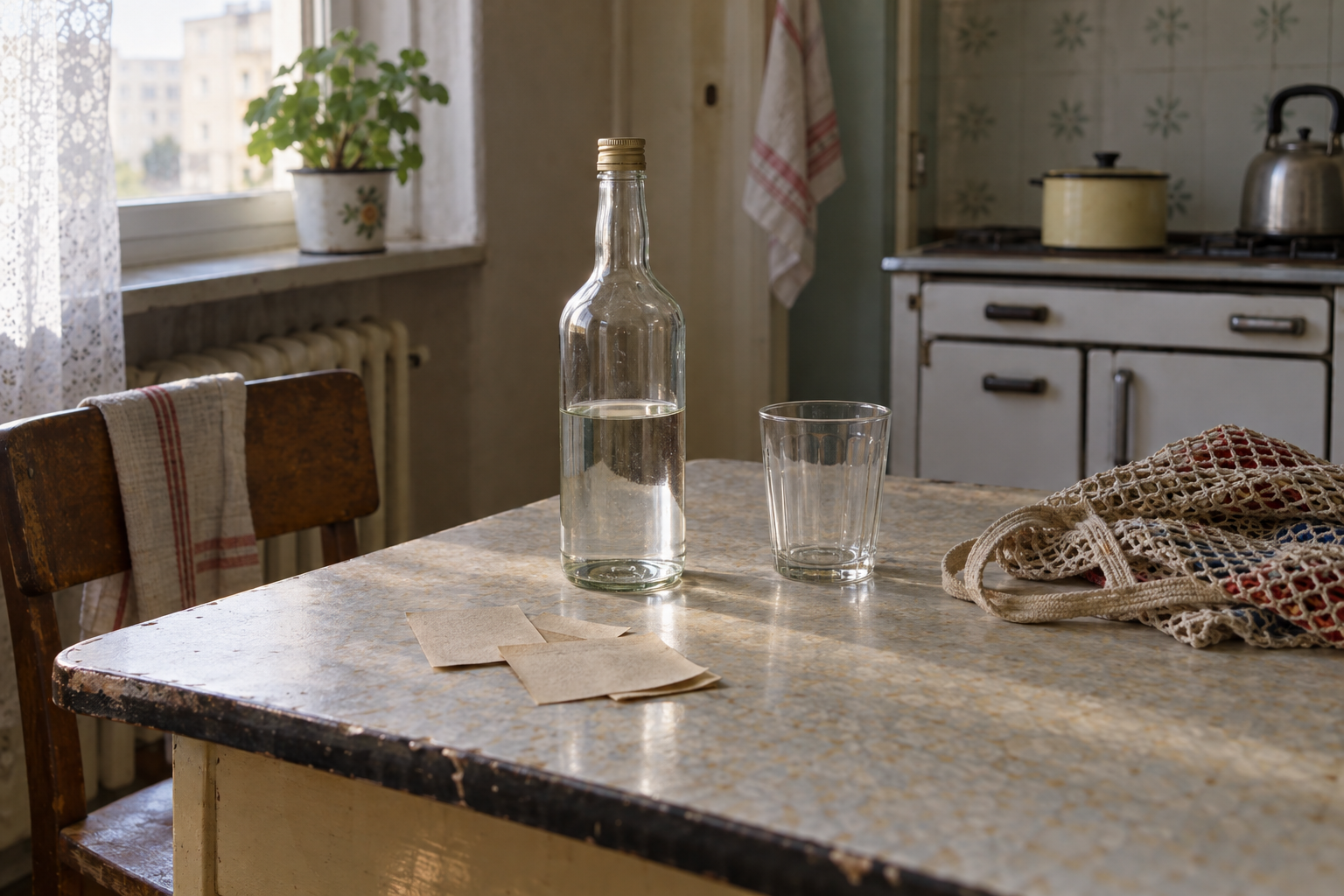
    An unlabelled vodka bottle beside paper coupons and a shopping bag on a worn kitchen table

    Vodka ration cards were not vouchers for free drinks

    The first distinction matters: a ration card gave permission to buy a specified quantity of goods. It did not replace money. At the counter, the customer paid and surrendered the appropriate coupon, or the shop assistant cut it from the card. Historian Andrzej Zawistowski describes this system in his account of Polish rationing. Think purchase entitlement, not complimentary bottle. Source: Polish History.
    Nor was vodka an isolated case. Sugar rationing returned in 1976; meat followed in 1981, alongside an expanding collection of controlled goods that included butter, chocolate, soap and cigarettes. Different products and groups of customers had different allocations. Shopping required more than remembering what was missing from the kitchen. Source: Polish History.
    Even the right paperwork could not guarantee that anything would be available. The NBP’s historical account explicitly notes that coupons sometimes failed to secure any goods at all. A ration card was permission to purchase, not a promise that the delivery van would arrive. Source: NBP Money Centre magazine.

    When vodka went on ration in Warsaw

    There was no single tidy national starting day. Towns and regions introduced their own alcohol controls in response to shortages. In Warsaw, rationed vodka sales began on 13 August 1981 using the reserve R-2 coupon from meat cards. Dedicated alcohol cards followed in September. Jan Oleński documents that sequence in the Institute of National Remembrance’s magazine, Pamięć.pl. Source: IPN, pages 50–52.
    Warsaw’s coupons marked A entitled the holder to a half-litre bottle of vodka, with specified alternatives. Non-drinkers could choose coffee, cocoa or chocolate products instead. This was not one universal allowance applied identically everywhere: local rules mattered. In January 1982, new nationwide cards brought greater standardisation. Source: IPN.
    The shortage could also be surprisingly literal. In Katowice in September 1981, customers had to bring empty bottles to exchange because the supply of bottles had become a problem. There was alcohol, but insufficient packaging. Source: IPN.
    Alcohol rationing ended in April 1983. It should not be confused with meat rationing, which continued until 1989. Source: Polish History.

    What a bottle could buy without being opened

    Historian Krzysztof Kosiński describes alcohol being used for small services and informal jobs, particularly in working-class settings. His account also makes an important qualification: alcohol often supplemented a transaction rather than replacing every other form of payment. Foreign cognac might accompany a more substantial favour; dollars remained important for the biggest dealings. Source: Historia pijaństwa w czasach PRL, page 566.
    So “vodka was a currency” is useful shorthand, not a claim that Poland abandoned cash and settled everything in half-litres. Kosiński places its growing importance particularly in periods of uncertainty and worsening shortages. The bottle’s usefulness depended on what someone else would accept in exchange. Source: Kosiński.
    The coupons themselves could circulate too. Poland’s government educational platform records people exchanging ration entitlements, including chocolate for vodka. That is a different transaction from handing over an actual bottle: one trades the right to buy, the other the goods already obtained. Keep that distinction in mind when looking at a ration card in a museum. Source: Zintegrowana Platforma Edukacyjna.

    Bimber: the bottle outside the official system

    Official shop supplies were only part of the story. Bimber means home-distilled alcohol, often called moonshine in English. Culture.pl’s account of everyday life under communism describes people making it from sugar, grain or potatoes when their vodka coupons ran out. It was a way around the controlled supply, not another allocation within it. Source: Culture.pl.
    That distinction is worth keeping when somebody tells a story about “the vodka we had back then”. Ask what they mean: a shop-bought bottle, home-distilled spirit, or something obtained through an exchange. Without that detail, a story about shopping can quietly turn into a story about production.
    I would also resist treating improvised production as evidence of superior flavour. Resourcefulness and good distilling are separate questions. A family recollection may be valuable social history without being a controlled tasting comparison. For the production side, keep our article on what defines Polish vodka as a separate read rather than assuming every clear spirit belongs in the same category.

    The state sold alcohol and warned people against it

    There was an uncomfortable contradiction behind the bottle. Spirits sales provided important income for the state, as Culture.pl notes, while official campaigns warned against drinking. Source: Culture.pl.
    A historical study published in the American Journal of Public Health examined Polish anti-alcohol posters and found messages about work, accidents, family life and social behaviour. Many presented the drinker as someone failing society, rather than concentrating narrowly on medical consequences. The researchers also show how artists used metaphor and ambiguity to complicate the official message. Source: Anti-alcohol Posters in Poland, 1945–1989.
    That makes the posters worth more than a quick glance at their graphics. Look at what each one asks of the viewer: protect a family, avoid an accident, become a better worker. Then place it beside the ration card. One object tries to shape behaviour; the other regulates access. My suggestion is to read them together, rather than treating either as a complete explanation of Polish drinking culture.

    Where to explore this history in Warsaw

    For the domestic setting, consider Warsaw’s Life Under Communism Museum at Piękna 28/34. The Warsaw Tourism Office lists everyday objects and recreated settings including a flat, shop and café. Those are useful surroundings for thinking about the practical business of obtaining goods, rather than viewing vodka history only through distillery equipment. Source: Warsaw Tourism Office.
    When examining a ration card, start with three questions: where was it issued, when was it valid, and what did each coupon permit? When discussing an old bottle, add a fourth: was it intended for drinking, giving or exchanging? These questions will get you further than asking how much people could drink.
    For planning the rest of your visit, see our comparison of a Warsaw tasting, tour and museum visit. If you would like to continue the conversation over food, you can book a private Warsaw vodka tasting. Non-drinkers are welcome too. The point is culture, history and food, not getting drunk.
    Taste it for yourself

    Book a Polish vodka tasting or tour.

    Choose a seated tasting or a guided tour in Warsaw, Krakow, Gdansk, Wroclaw or Poznan.

    Choose your city →