News & guides · 17 November 2026 · 5 min read
The Sugar Your Vodka Label May Not Mention
Plain vodka can legally contain added sugar. In the EU, the vodka category permits limited sweetening to soften the final taste. That does not mean every producer uses it, but it does mean that an unflavoured bottle is not automatically an unsweetened one. The allowance appears in [Annex I of the EU spirits regulation](https://eur-lex.europa.eu/eli/reg/2019/787). For a visitor choosing Polish vodka, three separate questions matter: does it taste sweet, has anything been added, and what does its legal name actually guarantee? Keep those questions separate. Your tongue has useful opinions, but it is not a laboratory.
A sweet taste does not prove there is sugar
Ethanol, the alcohol in vodka, produces more than a burning sensation. In a sensory study of ethanol mixed with water, participants reported sweetness alongside bitterness, drying and burning or tingling. Sweetness was relatively weak; at the higher concentrations tested, burning dominated. Crucially, those samples were ethanol-and-water mixtures, not sweetened vodka recipes.
The practical implication is modest but important: noticing sweetness does not, by itself, establish that a producer added sugar. Nor does finding a vodka sharp or bitter establish that none was added. That is an inference from the study, not a method for measuring a particular bottle’s contents. The researchers also found differences in how participants perceived the samples.
When making notes, I suggest separating sweetness from texture and heat. Write down what you notice rather than trying to identify an ingredient immediately. For a broader vocabulary, read our article on what vodka tastes like. Here, the useful distinction is between a sensory impression and a recipe.
How much sugar can plain vodka contain?
Under EU rules, vodka may contain up to 8 grams of sweetening products per litre, expressed as invert sugar, to round off its taste. This is the regulation’s measurement basis, not a requirement to use a particular sweetener. The same category prohibits colouring. A clear appearance therefore does not answer the sugar question. These provisions sit together in the legal definition of vodka.
The important word is may. The ceiling is not a standard recipe, an average sugar content or evidence about any named brand. It would be just as misleading to say that all vodka contains sugar as to say that none can. The regulation permits sweetening; it does not require it.
My advice is to treat sweetening as a production detail worth understanding, rather than an automatic verdict on quality. You might prefer an unsweetened recipe, or simply prefer the taste of a particular bottle. Those are different buying decisions, and neither needs a dramatic speech about purity.
Why protected Polish Vodka has a different answer
Polska Wódka / Polish Vodka is a protected geographical indication, not merely a description of where a bottle happens to come from. Its specification distinguishes plain vodka from flavoured vodka. For the plain version, no additives other than water are permitted, including sugar added to soften the taste. See the official product specification.
The specification also requires alcohol derived from Polish-grown rye, wheat, barley, oats, triticale or potatoes, with every production stage taking place in Poland. Triticale is simply one of the permitted crops; you do not need to memorise the list to choose a bottle. The useful buying distinction is the protected designation, rather than a general impression of Polishness. The production requirements are set out in the same specification.
There is an important exception to remember: the protected name also covers a flavoured category with its own sugar allowance. Do not carry the plain version’s no-additives rule across to it. The official register lists both categories. Our article on Polish vodka’s production rules provides the wider context.
Why the back label may not settle it
For vodka, the general EU food-information rules do not require the full ingredients list and nutrition declaration you would expect on many foods. The European Commission explains the exemption for alcoholic drinks above 1.2% alcohol by volume on its alcohol-labelling page. An absent sugar figure is therefore not evidence of zero sugar.
That leaves a small piece of homework if the recipe matters to you. Look for the producer’s product-specific ingredients or nutrition page, rather than relying on a general brand slogan. The Commission also records industry commitments to provide information beyond the bottle, including ingredients online. Off-label information is part of the spirits sector’s labelling approach.
My suggested checking order is simple:
- Match the exact product name, not just the brand.
- Check that the page refers to the bottle and market you are buying from.
- Look for a sugar figure or an explicit statement about added sugar.
- If the answer remains unclear, ask the producer rather than treating silence as confirmation.
This is especially worthwhile when choosing a gift for someone who cares about how their spirits are made. It gives you something more useful to discuss than the bottle’s weight.
Vanilla notes and fruit flavours are not sugar measurements
Belvedere offers a useful example of why tasting language needs careful reading. Its producer describes the standard Belvedere Vodka as having almond and vanilla notes while also stating that it contains no additives. Those are the producer’s tasting descriptions and production claims, not independent laboratory findings. A vanilla comparison in tasting notes should not be read as an ingredients list.
The reverse assumption also needs checking: a fruit-flavoured product does not automatically have a high sugar content. Belvedere’s published nutrition information lists 0 grams of sugar per 100 ml for its Lemon & Basil product, alongside ingredients including lemon extract and basil flavouring. Its Organic Vodka entry also lists zero sugar. These are figures reported by the producer for those specific products, not a rule for every flavoured vodka.
For shopping purposes, put tasting notes and composition in separate mental drawers. Use the first to decide what sounds appealing. Use the second to answer questions about ingredients. Neither drawer needs to contain an argument about which drink is more respectable.
What to ask at a vodka tasting
Rather than asking a host to identify sugar by taste alone, I would ask three more useful questions: what is this product’s legal category, what does its producer disclose, and which sensations should we compare? That turns a vague discussion about smoothness into something you can follow up afterwards.
For a focused comparison, my suggestion is to choose two plain vodkas with documented recipes and similar alcohol strengths. Keep the glassware and serving temperature consistent, then note sweetness, bitterness, texture and heat separately. Matching strength matters because the ethanol study found that concentration changed the balance of sensations.
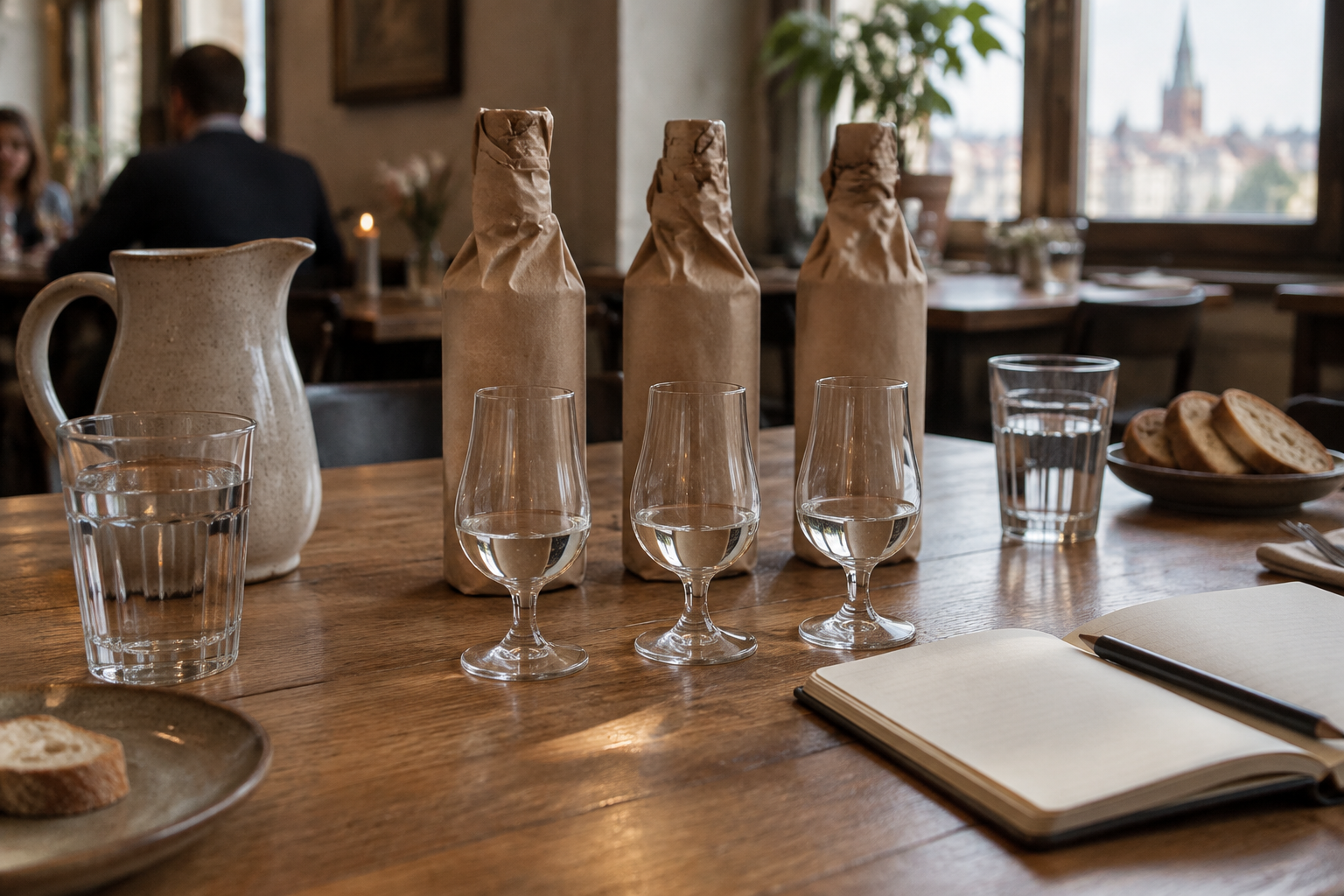
Do not turn the exercise into a test you must pass. A small sip is enough for a note, and leaving a sample unfinished is perfectly reasonable. If you want a structured way to record impressions before reading the labels, use our blind vodka tasting format. Treat the result as a record of preference, not a home sugar assay.
For a hosted comparison, enquire about a private group vodka tasting in Warsaw. Non-drinkers are welcome too: the food, history and cultural conversation are part of the experience, not an interval between drinks.
Sources
- EU Regulation 2019/787: consolidated spirits definitions, Annex I
- Perceptual Qualities of Ethanol Depend on Concentration, and Variation in These Percepts Associates with Drinking Frequency
- Polska Wódka / Polish Vodka: official product specification
- GOV.UK protected spirit drink register: Polska Wódka / Polish Vodka
- European Commission: Alcohol labelling
- Belvedere: producer descriptions of its vodka collection
- Belvedere: product nutrition and ingredient information
Taste it for yourself
Book a Polish vodka tasting or tour.
Choose a seated tasting or a guided tour in Warsaw, Krakow, Gdansk, Wroclaw or Poznan.
Choose your city →